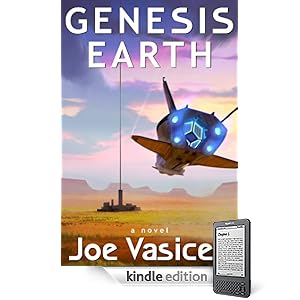
Buy it here.
Joe's Blog
Amazon Review - Four out of Five Stars
The first thing I'd like to point out is I'm not an avid reader of the sci-fi genre. I love the genre in different forms of media, specifically movies and video games, but when it comes to READING sci-fi it usually isn't my first choice. So when I gave Genesis Earth a go I was pleasantly surprised by how engrossing and interesting it was, even from the first page. Vasicek has created a world that readers will find both technologically sound and incredibly interesting.
The second point is how extremely well editing the novel is in terms of grammar, spelling, punctuation, and general layout. Having read a handful of indie published Kindle books, a rather unfortunate stigma of the market is that most books have frequent grammar, spelling, and formatting issue. It is clear Vasicek spent a good deal of time perfecting this novel before putting it out on Kindle, which is a boon in and of itself.
The basic concept of the book is that our main hero Michael has lived his whole life in a space station, in the shadow of his super-scientist father. When mankind opens an artificial wormhole and finds what appears to be an inhabitable planet on the other side, Michael accepts the task of going through with the only other crewmember, Terra, to discover the planet and basically see what's up.
The initial chemistry (or lack thereof; they bicker frequently) between Michael and Terra is extremely amusing, especially with Michael basically looking for symptoms of mental illness in the girl. That was probably the funnest part of the book, watching Michael and Terra play off each other as their completely different personalities clashed frequently.
Once they arrive on the other side of the wormhole, things go from "interesting" to "weird" to "wait what?" There are several rather startling reveals throughout the book that kept me reading just to see what Vasicek would throw at me next.
I only have two complaints with Genesis Earth. First, the eventual chemistry (read: romance) between Terra and Michael seems phoned in. While I can understand they are the only two people alone on this starship and there was pretty much no way at all the book would NOT hook them up, the situations that lead to their eventual romantic interest don't seem to merit the sudden rush of fondness they feel for each other.
My second complaint was that the viewpoint character, while extremely technologically competent (which I am thankful for; I know nothing about sci-fi) came off as dry in several parts. I can understand it being his personality, but frankly his dead-panning of certain climactic scenes sort of took the wind out of the book's sails. I think it would be AWESOME to read this book from Terra's viewpoint, as she is both unstable and incredibly interesting.
Overall, if you are an avid indie reader, you really should pick this book up. It's a rather bright beacon of quality amongst a dark expanse of mediocrity. Even if you don't like sci-fi it should certainly be worth investigating, as the story is riveting and characters captivating.
Also, I kept humming "The Final Countdown" by Europe every time their spaceships were flying around. Is that weird? Whatever.
Director's Cut!
Here are some random thoughts about the book that I didn't put in the review because they were stupid ideas.
- I kept waiting for one of the characters to turn into this crazy, psycho murderer that stalked the starship like on Sunshine. Then I realized there were only two characters so that made no sense.
- I also kept waiting for a Planet of the Apes moment where they land on the planet and are like, "THE STATUE OF LIBERTY!" Thankfully, that didn't happen either.
- I wasn't lying about the Final Countdown thing. Here, now YOU can listen to it.
- I've always been curious about faster then light travel, but no sci-fi games or movies really take into account the fact that if you travel that fast EVERYBODY ELSE GETS REALLY OLD. I liked how this book mentions that frequently.
- When you find out exactly where/when they are after going through the wormhole...it's pretty dang epic. Just saying, I didn't see that twist coming.
- I'm in Space. SPPPAAACCEE!!!
(stop at 3:30 unless you want to spoil Portal 2's ending)
Showing posts with label Joe Vasicek. Show all posts
Effulgent Corruption, Nier, and guest blogging
First off: I wrote a monsterously long blog post about character development in response/collaboration with Joe's bit I posted here. Read it now.
Next, I wrote 5k in Effulgent Corruption yesterday; an entire chapter. It was also an especially potent scene that I'd had planned literally since the book's initial inception, so writing it was extremely exciting and gratifying. I'm very satisfied with how it turned out, though I might be adding a little more to the end before the chapter break. Major revelation/twist with regard to viewpoint characters. EXCITING.
I write better when I write in chunks. I wrote 2k from 4-5pm while waiting for my wife to get done with work (we work at the same place but rarely the exact same hours, so if I get finished sooner I write in the lobby). Then I sat on my magical hill that is quickly becoming "hay fever central" with all the stupid grass and wrote another large chunk. Good stuff. I should get off work early every day.
Lastly, I beat the game Nier. I linked the wiki, but don't read the plot. Here is why.
This game has a GREAT story. I'm usually pretty jaded against JRPG plots. I enjoy the, but they tend to be seeped in melodrama and exposition rather than actually letting the reader/gamer discover things themselves.
The best part about Nier is it explains the final plot twist near the end, then explains NOTHING else. It forces you to put the pieces together, and when you do everything (including a prologue that seemingly had nothing to do with the rest of the game) snaps together into an incredible finale.
The twist also changes the truth about what you've been doing the entire game. After beating it you can replay it to learn more about one of your companions (you basically replay the second half with added commentary/cutscenes). But now that you know the twist, some of the things the game makes you do (which you did just fine in the first playthrough with no emotional attachment) are horrific. Rarely does a game make you own up to what you've done, but Nier does it an in spades. Once you realize the truth behind not only the bosses but the events leading to them you realize that nothing about the game was what it seems. But it still all makes perfect sense, which is a superb example of a well crafted story.
I'm rambling, but I'm going to go so far as to say Nier has the best story of any JRPG ever made. If not the best, at least the tightest. There is little to no filler and stuff that doesn't make sense the game takes care to explain over multiple playthroughs. It is exceptionally well crafted. I highly recommend it (plus you can get the game for about $10-15 despite coming out next year).
Know it's steeped in mediocrity, but the payoff is totally worth it.
That's it from me, enough about dumb video games. Nathan out.
Guest Post: Character Development in Sci-Fi by Joe Vasicek
(Blogger's Note: Joe Vasicek is a fellow author who also sports a red beard. He has published an assortment of short stories on Kindle and recently released a full length novel, Genesis Earth, complete with hot cover art on Kindle as well. You should go check it out; links to the novel and blog are after the article)
When it comes to writing characters, I like to keep two rules in mind:
1) Every character is the hero of his/her own story
2) Every story has a beginning, a middle and an end
The first rule basically means that if I wanted to recast my novel with any given NVC (non viewpoint character) as a VC, the story should be about them, not about someone else. It doesn't mean that everyone should be heroic; the Joker sees himself as the "hero" (or "main character") of his own story, but I'm pretty sure he doesn't think of himself as a hero.
The second rule is so obvious it seems like it shouldn't bear mentioning, but if you stop to think about it, you'd be surprised. When applied to characters and character arcs, it basically means that every character should have an origina and a destiny: some kind of backstory (including parents/siblings or lack thereof), and some sense of where their life is heading.
Backstory helps out a ton in figuring out a character's motivations: not just what they want but why they want it. For example, in Genesis Earth I wanted my main character (Michael Anderson) to be the son of two of Earth's most brilliant scientists. Consequently, I figured he would feel a tremendous amount of pressure to live up to their legacy.
But it didn't end there. These scientists had left with a team to create mankind's first artificial wormhole, but because playing with naked singularities is dangerous (seriously, don't try it at home), they had to spend several years traveling across space to get far enough away to experiment safely. Consequently, Michael has never set foot on Earth--but he's grown up with constant reminders of the planet, since his parents miss their home world so much.
From that, I figured that Michael would develop an unhealthy obsession with Earth. This connected very well with my original story idea, since I wanted him to explore an Earthlike world. It's one thing to describe a setting the way that anyone would see it; it's quite another to describe it through the eyes of someone who has a deep personal interest in what he sees.
For the main female character (Terra Beck), I wanted someone with the exact opposite set of motivations--someone who would provide conflict, and thus drive the story. If Michael wanted to go on the mission because of the pressure from his parents to be a world-renowned scientist, I figured Terra would just want to get away from everyone and everything. To give her that motivation, I made her parents divorced; in a small, enclosed community like a space station, I figured that a nasty divorce would be a hard thing to grow up with, especially if everyone on the station took sides. So even though Terra agrees to the mission, she doesn't really care about it.
Motivation is about more than what your characters want: it's why they want what they want. You can break it down by playing the annoying five year old kid and asking them "why?" over and over. Done well, it's inextricably connected with their origin and destiny; it grows out of their backstory and informs the sense of direction in their lives.
Strengths and weaknesses also grow out of origin and destiny. For Terra, I figured she would grow up as something of an outcast, hating everyone around her. Consequently, I figured she'd develop some disorders. One of the funnest parts of writing the book was taking an online diagnostics test to see what mental illnesses she was predisposed to. I did this after I'd finished the rough draft, so I had some sense of who she was already, and used that to answer the questions as if I were here. The test results gave me a ton of delicious material to work with.
So those are the things I keep in mind when developing my characters. I don't believe in following a set method or running down a long checklist, since every character is different. Sometimes, I just toss them in as I'm writing, and things turn out great. Other times, I take detailed personality tests and outline a long and complicated backstory. But every time I add a new character, I ask myself: "what's this character's story?" If I don't feel that there's at least the potential to write an interesting novel from their point of view, I stop and figure them out.
Why? Because I believe Neil Gaiman was right when he said:
"Everybody has a secret world inside of them...no matter how dull and boring they are on the outside, inside them they've all got unimaginable, magnificent, wonderful, stupid, amazing worlds. Not just one world--hundreds of them. Thousands, maybe."
And that is one of the biggest reasons why I love being a writer.
Joe Vasicek is a science-fiction writer who pretty much knows what is going down. His novel, Genesis Earth, is an exceptionally well-edited and well-produced sci-fi extravaganza complete with wormholes, first contacts, space stations, and cryofreeze. Basically you've got everything you could ever want in a science fiction novel going on in here. You can grab it off Amazon for your Kindle and enjoy a fantastic read. So go do it. Now. I'm waiting.
Subscribe to:
Posts (Atom)
